
Security and privacy reviews have long been a standard part of how enterprises evaluate software vendors. For SaaS and AI providers, AI vendor due diligence can add a second set of questions, focused on how the AI inside the product is tested, overseen, and documented.
Key Takeaway
AI vendor due diligence can ask providers to show how their AI systems are evaluated, monitored, and governed. Enterprise SaaS and AI providers can support these assessments by keeping consistent records of output quality, human oversight, identified issues, and corrective actions. Validation by licensed attorneys adds structured review findings that support customer questionnaires, procurement assessments, and ongoing vendor oversight.
Enterprise buyers evaluating AI-enabled products may want to know how systems are tested, how outputs are validated, what human oversight exists, and how risks are addressed. For product leaders and legal teams, answering takes coordination across product, engineering, compliance, and governance.
Policies and technical documentation explain how a system is designed. Customers may also ask for evidence of how those controls operate in practice, and structured human validation produces that evidence through documented output reviews, quality-control findings, and escalation records.
For SaaS and AI providers, the ability to produce credible validation evidence can help address procurement questions, reduce repeated documentation requests, and support enterprise customer evaluations.
What AI Vendor Due Diligence Covers
Traditional software vendor reviews cover cybersecurity, data protection, business continuity, and contract terms. Products that generate content, recommendations, or classifications add questions about reliability, limitations, and oversight, and those questions can involve procurement, privacy, legal, compliance, and AI governance teams.
Customer AI due diligence questionnaires can ask about:
- Intended uses, capabilities, and known limitations
- Testing and validation methods
- Human oversight and intervention procedures
- Accuracy controls and handling of unsupported outputs
- Incident escalation and remediation
- Monitoring after deployment or material product changes
- Documentation supporting governance claims
For providers serving many enterprise customers, these requests recur with different wording, documentation standards, and internal risk classifications. A consistent validation and documentation process lets providers answer them without building a separate evidence package for every customer.
Regulations Shaping AI Vendor Assessments
Two legal frameworks address what AI providers and developers must supply to the organizations that use their systems: the EU AI Act and Colorado’s updated AI law.
EU AI Act: Human Oversight Across the AI Value Chain
Article 14 sets human oversight requirements for high-risk AI systems. The people responsible for oversight must be able to understand the system’s capabilities and limitations, monitor its operation, interpret its outputs, recognize over-reliance, and override or intervene when needed.
Article 25 addresses responsibilities along the AI value chain. Organizations can take on provider obligations if they put their name on a high-risk system, substantially modify one, or change the intended purpose of an AI system so that it becomes high-risk. Article 25(4) also addresses written agreements between providers of high-risk systems and third parties supplying AI tools, services, components, or processes used in those systems. These agreements cover the information, technical access, and assistance the provider needs to comply, subject to the provision’s specific scope and exceptions.
These obligations depend on how a system is classified and the organization’s role, so they do not apply identically to every AI-enabled SaaS product. Under the Digital Omnibus on AI, high-risk obligations apply from December 2, 2027, for Annex III systems and August 2, 2028, for Annex I systems.
Colorado SB 26-189: Developer Documentation
Colorado SB 26-189 sets documentation requirements, beginning January 1, 2027, for developers of covered automated decision-making technology used to materially influence consequential decisions. Covered developers must give deployers documentation on:
- Intended uses and known harmful or inappropriate uses
- Categories of training data
- Known limitations, risks, and uses to avoid
- Instructions for appropriate use, monitoring, and meaningful human review
The law also requires notice to deployers of material updates and retention of compliance records. Its reach depends on whether the technology and its use fall within the statutory scope, and implementation details remain subject to ongoing Attorney General rulemaking.
Moving From Governance Policies to Documented Evidence
AI governance frameworks set responsibilities, risk classifications, testing requirements, and escalation protocols. But a policy describing how outputs should be reviewed is different from a record showing how specific outputs were evaluated.
If a vendor states that higher-risk outputs receive human review, a customer may ask for the selection criteria, reviewer qualifications, documented findings, and records of how issues were resolved. A structured validation process produces those records through:
- Review criteria tied to product use cases
- Consistent evaluation of AI-generated outputs
- Classification of accuracy, completeness, and compliance issues
- Documented findings, escalations, and corrective actions
- Quality-control reporting across review periods or product versions
The same records help internal teams see where problems occur and whether controls are working consistently.
Integrating Human-in-the-Loop Review Into SaaS Governance
Automated evaluation tests technical performance, detects defined policy violations, and tracks changes in output behavior. Human-in-the-loop validation complements it by applying qualified judgment to outputs that call for interpretation, specialized knowledge, or assessment against standards that cannot be reduced to automated rules.
A structured workflow typically follows six steps:
- Define the review population. Identify the products, features, and output categories that need human evaluation.
- Set evaluation criteria. Define standards for accuracy, completeness, source support, consistency, and applicable legal or policy requirements.
- Assign qualified reviewers. Match reviewer expertise to the subject matter and the consequences of an incorrect output.
- Classify and document findings. Record each issue, its severity, the output category, and the criteria applied.
- Correct or escalate. Resolve errors, refer complex findings to specialists, and document final dispositions.
- Report and improve. Aggregate findings to spot recurring problems and inform product development.
This runs alongside existing engineering, product quality, and governance functions, and its documentation becomes evidence for customer assessments. Our guide on validating AI-generated outputs before product release covers where review fits in a release cycle.
Using Attorney-Validated Outputs as Due Diligence Evidence
Not every AI output needs legal review. An output can read as accurate while containing an unsupported conclusion, a material omission, or an incorrect regulatory interpretation. For products generating legal, regulatory, or compliance content, review by licensed attorneys evaluates these issues where general quality-control processes may fall short.
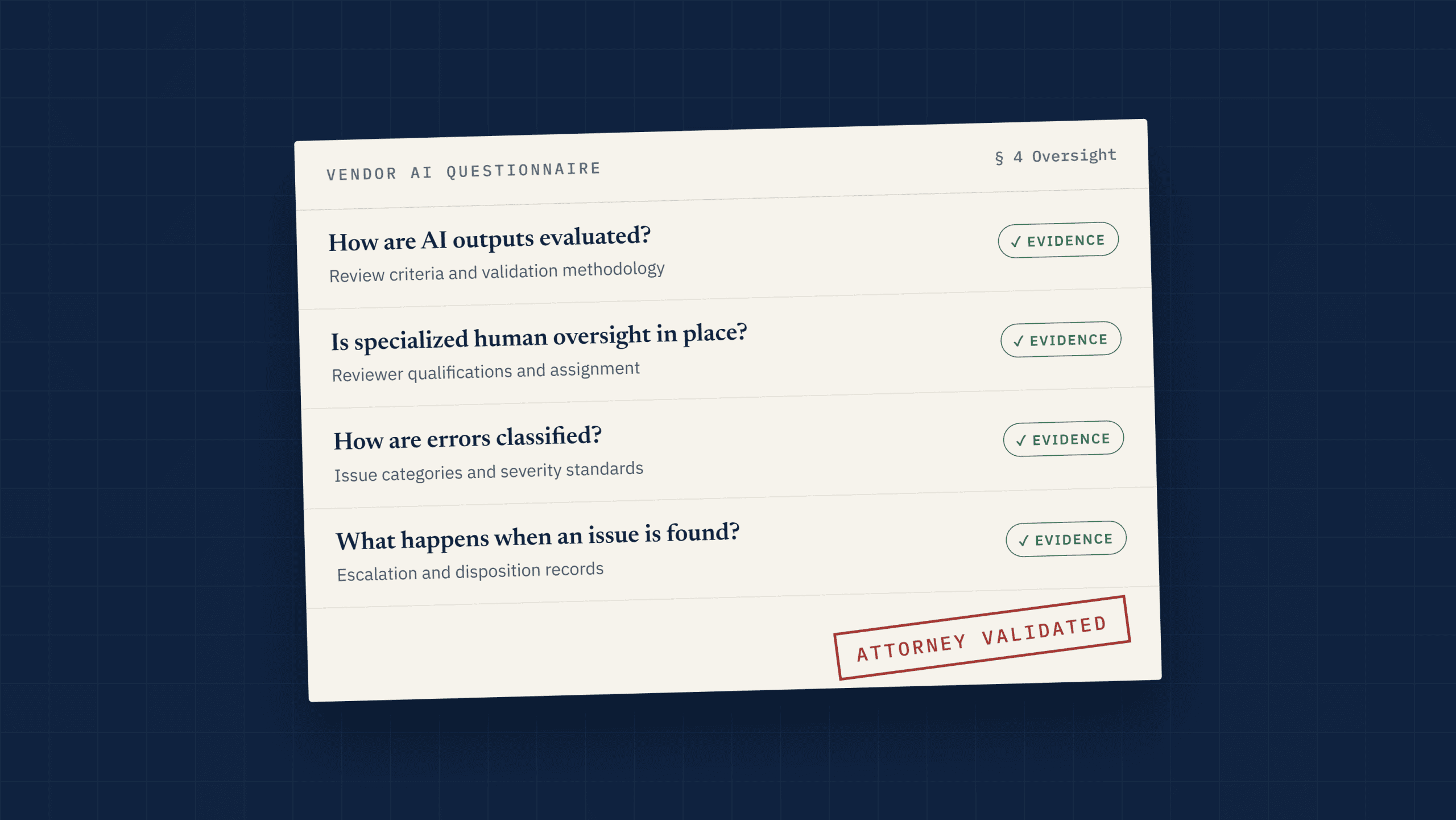
When a customer questionnaire asks how a provider validates compliance-related outputs, a structured validation summary can answer with evidence rather than a policy description:
| Customer due diligence question | Supporting evidence |
| How are AI outputs evaluated? | Review criteria and validation methodology |
| Is specialized human oversight in place? | Reviewer qualifications and assignment procedures |
| How are errors identified and classified? | Issue categories, severity standards, and findings |
| What happens when a material issue is found? | Escalation procedures and disposition records |
| How is output quality monitored? | Sampling methodology and quality-control reports |
| How are recurring problems addressed? | Trend analysis and corrective-action records |
This evidence should be presented within its actual scope. A sampled review does not establish that every output is accurate, and attorney validation does not certify that a product meets every applicable regulatory requirement. The value lies in the review process and the records it produces.
Scaling Validation Into a Reusable Evidence Framework
Providers often run several AI-enabled products, serve customers across regulated industries, and update models, prompts, and features frequently. Reviewing every output the same way is rarely necessary or practical. A scalable approach matches review intensity to risk: structured sampling for lower-risk outputs, and targeted review by qualified specialists for higher-risk content. Intensity can increase after a material product update, a pattern of recurring issues, or a new regulated use case.
Standard review criteria, issue classifications, escalation thresholds, and reporting formats let the same findings serve product quality, governance monitoring, release management, and customer due diligence. Over time, they form a reusable evidence framework that typically includes:
- Product descriptions, intended uses, and known limitations
- Governance policies and assigned responsibilities
- Testing and validation methods
- Human oversight procedures and reviewer qualifications
- Aggregated validation results and escalation records
- Monitoring and material-change documentation
Providers can map these materials to common customer questions while protecting confidential information through summaries, redacted evidence, or controlled access. Keeping one evidence set also helps legal, compliance, product, and sales teams answer requests consistently and see where documented controls and operational evidence fall out of step.
How Baer Reed Supports AI Vendor Due Diligence
Baer Reed’s human-in-the-loop validation for technology companies gives enterprise SaaS and AI providers a structured review process for AI-generated content, particularly where legal, regulatory, or compliance expertise matters. Licensed attorneys apply defined evaluation criteria within scalable quality-control workflows, with issue classification, escalation procedures, and audit-ready reporting.
Providers use the service to:
- Validate AI-generated legal, regulatory, and compliance content
- Document human oversight and output review procedures
- Produce structured findings for customer AI due diligence questionnaires
- Keep review methods consistent across products and use cases
- Continue validation as products and customer requirements change
The resulting findings, quality-control records, and escalation reports support customer AI due diligence questionnaires while complementing existing product testing and governance programs. Contact Baer Reed to learn how AI Output Validation & Oversight can support your customers’ next due diligence review.
FAQs
What is AI vendor due diligence?
AI vendor due diligence is the process enterprise customers use to evaluate an AI provider’s technology, governance, risks, controls, and documentation before or during a commercial relationship. It typically covers capabilities, limitations, testing, human oversight, data protection, monitoring, and incident response.
Read More: How to Validate AI-Generated Outputs Before Product Release
What evidence should AI vendors provide in customer due diligence questionnaires?
Depending on the product and the customer, vendors provide system documentation, testing methods, human oversight procedures, validation results, issue classifications, escalation processes, and monitoring records. Evidence should accurately reflect the scope and results of the underlying controls.
Read More: Human-in-the-Loop Validation: The Operational Layer in Regulated AI Deployment
Does the EU AI Act require human oversight for enterprise AI products?
Article 14 sets human oversight requirements for AI systems classified as high-risk. Those requirements do not apply identically to every enterprise AI product; obligations depend on the system’s classification and the organization’s role. Under the Digital Omnibus on AI, high-risk obligations apply from December 2, 2027, for Annex III systems and August 2, 2028, for Annex I systems.
Read More: EU AI Act Article 14: Human Oversight
What does Colorado SB 26-189 require from AI developers?
Beginning January 1, 2027, developers of covered automated decision-making technology must give deployers documentation on intended uses, training data categories, limitations, and instructions for appropriate use, monitoring, and meaningful human review..
Read More: Colorado SB 26-189
How can human-in-the-loop validation support enterprise AI procurement?
Structured human validation produces documented evidence of how AI outputs are evaluated, how errors are classified, and how issues are corrected or escalated. Providers can use appropriately scoped findings to support customer questionnaires, procurement reviews, and ongoing governance assessments.
Read More: AI Output Validation & Oversight Services