

Key Takeaway
Enterprise AI copilots are making it faster for financial services organizations to create summaries, emails, marketing content, client communications, and other business materials. That efficiency can also increase the volume of AI-assisted content moving through existing compliance processes.
For regulated organizations, the central issue is not whether AI was involved in creating a communication, but whether the final content meets the same accuracy, disclosure, supervision, and other applicable standards as content created through traditional workflows. A structured validation process can help organizations incorporate AI-generated drafts into existing review processes without treating every AI-assisted communication as either inherently reliable or inherently high risk. This is the core function of enterprise AI copilot validation: applying consistent, risk-based review to AI-generated content before it reaches clients, regulators, or the public.
AI Changes Content Creation, Not the Compliance Standard
Generative AI can significantly accelerate the first stages of content development. Employees can use copilots to summarize source materials, draft client emails, develop marketing language, adapt existing content, and generate responses to common questions. In financial services, however, using AI to create or assist with a communication does not remove the regulatory obligations that would otherwise apply.
FINRA has stated that its rules are technology neutral and continue to apply when member firms use generative AI, and that the content standards governing communications with the public apply whether those communications are generated by a person or a technology tool. For investment advisers subject to the SEC Marketing Rule, advertisements remain subject to requirements designed to prevent materially false or misleading statements, including material omissions and claims that cannot be appropriately substantiated.
Enterprise AI copilot validation therefore needs to focus on the content itself, its accuracy, and how it will be used, regardless of the role AI played in its creation.
Identifying Risk in AI-Generated Communications
Many AI-generated drafts will appear polished and professionally written, but that does not necessarily mean they are ready for external use. Potential issues may include:
- Statements that are factually inaccurate or unsupported
- Material information omitted during summarization
- Language that changes the meaning of an underlying source
- Performance or product claims presented without appropriate context
- Required qualifications or disclosures that are missing or incomplete
- Inconsistent terminology across related communications
- Outdated information incorporated into a new draft
- Statements that are technically accurate but potentially misleading in context
Summarization presents a particularly important challenge, since an AI system may accurately condense most of a source document while excluding a qualification, limitation, or exception that materially affects the meaning of the resulting communication.
The relevant question is therefore not simply whether the draft contains an obvious hallucination. Review should determine whether the communication remains accurate, complete, appropriately supported, and suitable for its intended audience and use.
A Risk-Based Framework for Enterprise AI Copilot Validation
Organizations do not necessarily need to establish an entirely separate compliance process for every communication touched by AI. Instead, enterprise AI copilot validation can be incorporated into existing content review and supervisory workflows using defined risk criteria.
The level of review may vary based on:
- Type of communication
- Intended audience
- Subject matter
- Distribution channel
- Regulatory requirements
- Potential consequence of an error
For example, an internal meeting summary may present a different risk profile than a client-facing explanation of an investment product, and a first draft of general educational content may require different controls than material containing performance information or specific financial claims.
Establishing these distinctions allows organizations to apply more intensive review where the potential regulatory or customer impact is greater.
Structuring the Review Process
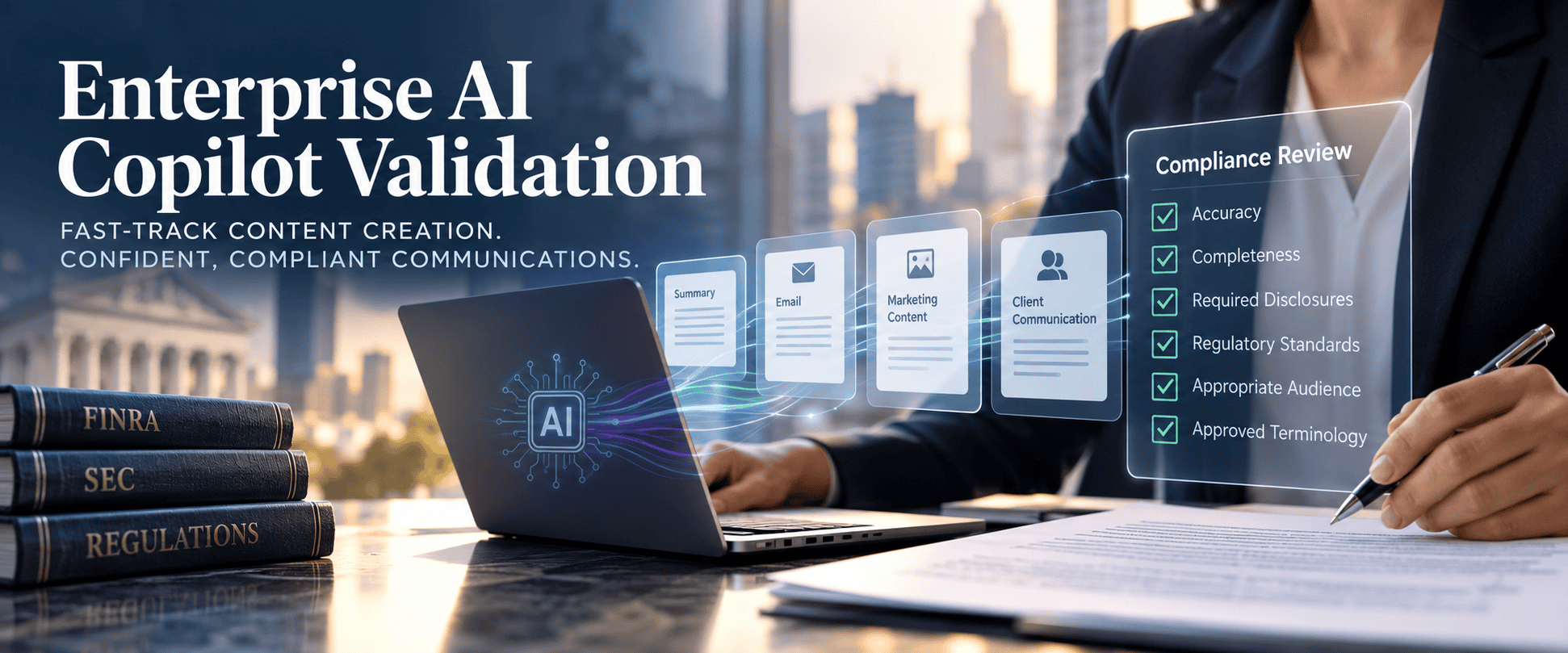
A scalable validation process begins with clear review criteria. Organizations can establish standards for:
- Factual accuracy
- Source fidelity
- Completeness
- Required disclosures
- Prohibited or restricted claims
- Approved terminology
- Other requirements relevant to the communication
Reviewers can then classify identified issues by type and severity, document required corrections, and escalate content that requires additional compliance or subject-matter review. This creates a repeatable workflow:
AI-assisted draft → risk classification → validation → correction or escalation → approval → release
The process can also generate structured data about recurring errors. If validation consistently identifies the same types of omissions, unsupported claims, or source discrepancies, those findings can inform changes to prompts, templates, source materials, employee guidance, or technical controls.
Aligning Reviewer Expertise With Content Risk
Effective review also depends on who is evaluating the output. Some AI-generated materials may be assessed through established quality-control procedures, while others may require reviewers with specific legal, compliance, financial, or regulatory knowledge. This distinction becomes important when an error is difficult to identify without understanding the underlying subject matter.
A statement may be grammatically correct and factually plausible while still omitting a required qualification or inaccurately representing a financial concept. Similarly, a summary may closely track its source while removing context that changes how a customer could interpret the information.
For higher-risk communications, validation should account for both the quality of the AI output and the expertise necessary to evaluate it.
Integrating Validation Into Enterprise AI Workflows
As organizations expand access to enterprise copilots, content creation can become increasingly decentralized, with employees across marketing, sales, client service, operations, and other functions able to generate drafts without relying on traditional content-production workflows. That makes process design increasingly important.
Organizations can define which AI-assisted materials require review, establish criteria for escalation, identify appropriate reviewers, and maintain documentation appropriate to the applicable workflow. Validation can occur before external distribution and can be adjusted as organizations gather performance data about specific tools and use cases.
The objective is not to add unnecessary friction to every use of generative AI, but to establish controls proportionate to the risk of the communication and the regulatory obligations associated with it.
Supporting Scalable AI Adoption in Regulated Communications
Enterprise copilots can increase the speed and volume of content creation. For financial services organizations, realizing that efficiency requires a review model capable of operating alongside it. Enterprise AI copilot validation gives organizations a structured way to evaluate AI-generated summaries and drafts against defined standards, identify material issues before distribution, and document the review process across higher-volume workflows.
Contact Baer Reed to learn how our validation services can support the review of AI-generated marketing, customer communications, summaries, and other regulated content.
FAQs
FINRA has stated that its rules are technology neutral and continue to apply when member firms use generative AI or similar technologies. The specific obligations depend on how the technology is used and the type of communication involved.
Read More: AI Output Validation and Oversight Services
Generative AI can be used to assist with content creation, but applicable regulatory, supervisory, recordkeeping, and communication requirements still need to be considered. Firms should establish processes appropriate to their specific use cases and regulatory obligations.
Read More: How to Validate AI-Generated Outputs Before Product Release
Review criteria may include factual accuracy, completeness, source support, required disclosures or qualifications, consistency with approved information, and compliance with applicable communication standards.
Read More: Human-in-the-Loop Validation: The Operational Layer for Regulated AI Deployment
Not necessarily. Organizations can establish risk-based review models based on factors such as audience, content type, distribution, subject matter, and potential impact. Higher-risk communications may require additional compliance or subject-matter review.
Read More: AI Output Validation and Oversight Services
Organizations can establish standardized review criteria, risk classifications, sampling or review methodologies, escalation procedures, and documentation requirements. Structured findings can also be used to identify recurring issues and improve upstream AI workflows.
Read More: Quality Assurance in Legal AI: Validating Models, Preventing Drift