

Key Takeaway
Financial institutions are increasingly using generative AI to support the creation of marketing materials, client communications, product descriptions, summaries, and other business content. Evaluating these materials through an AI-generated financial communications review process is becoming a necessary step, since AI can accelerate content development but does not change the regulatory standards that may apply to the resulting communication.
For organizations evaluating how to review AI-generated financial communications, the challenge is establishing a process that can identify substantive issues, apply the appropriate regulatory and internal standards, document findings, and operate at the volume AI-enabled content creation can produce.
A scalable review framework should account for both the risk of the communication and the expertise required to evaluate it.
Regulatory Standards for AI-Generated Financial Communications
FINRA stated that its rules are technology neutral and that the rules applicable to generative AI depend on how the technology is deployed. FINRA has also specifically noted that the content standards of Rule 2210 apply to covered communications whether they are generated by a human or a technology tool.
Investment advisers may face separate requirements under the SEC Marketing Rule. Among other provisions, the rule prohibits advertisements from including materially false or misleading statements and addresses substantiation, presentation of risks and benefits, performance information, and other marketing practices.
Taken together, FINRA and SEC guidance establish that AI-generated communications are held to the same content, disclosure, and substantiation standards as any other communication, based on their content, audience, and use.
Establishing the Scope of Review
An effective review framework begins by defining which AI-generated or AI-assisted communications fall within the process. Depending on the organization, this may include:
- Marketing and advertising materials
- Client and prospect communications
- Product and service descriptions
- Investment-related summaries
- Educational content
- Sales enablement materials
- Website and digital content
- AI-generated responses delivered through customer-facing applications
The appropriate review process may differ significantly across these categories. A general product description, for example, may require different review criteria than a communication containing performance information or investment-related claims.
Defining the scope allows organizations to align the level of review with the regulatory and business risk associated with each use case.
Defining Review Criteria
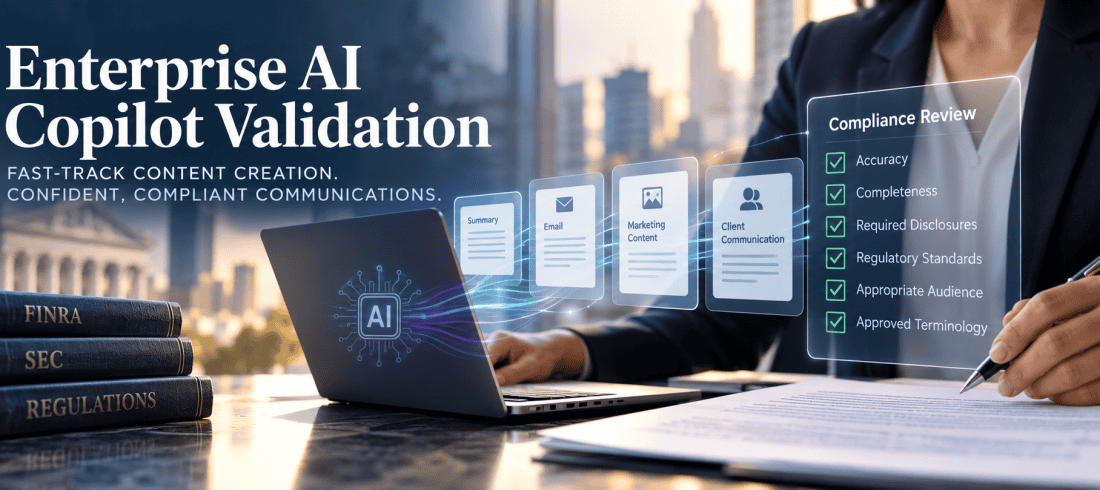
Once the scope is established, organizations need consistent standards for evaluating AI-generated content. Review criteria may include:
- Factual accuracy
- Completeness
- Source support
- Consistency with approved information
- Required disclosures
- Substantiation of material claims
- Appropriate presentation of risks and limitations
- Adherence to internal policies
AI-generated content can introduce issues that are not always obvious from a surface-level review. A draft may contain accurate individual statements while presenting them in a way that creates a misleading overall impression, a summary may correctly reproduce most of its source material while omitting an important limitation, and performance-related language may be generated without the context or accompanying information required for its intended use.
For that reason, review should evaluate the communication as a whole rather than relying exclusively on individual fact checking.
Aligning Review With Risk
A scalable framework does not necessarily apply the same review methodology to every piece of AI-assisted content. Organizations can classify communications based on:
- Intended audience
- Distribution
- Subject matter
- Regulatory significance
- Presence of financial or performance claims
- Potential impact of an error
Higher-risk categories may warrant comprehensive review by appropriately qualified personnel, while lower-risk content may be addressed through sampling, automated controls, established templates, or other quality-control methodologies.
The objective is to establish a defensible process that directs review resources toward the communications where errors or omissions could create the greatest regulatory, financial, or reputational exposure.
Matching Reviewer Expertise to the Communication
The effectiveness of a review process depends in part on whether reviewers are qualified to identify the issues that matter. Some content can be evaluated through standardized quality-control procedures, while other communications require knowledge of financial products, regulatory requirements, legal standards, or firm-specific policies.
This distinction is particularly important with generative AI because problematic outputs can appear polished and credible. A reviewer must be able to recognize not only obvious factual errors, but also unsupported claims, omitted qualifications, inappropriate comparisons, potentially misleading implications, and other substantive issues that may require specialized knowledge.
For organizations evaluating external review providers, reviewer qualifications and subject-matter alignment should therefore be considered alongside technology, capacity, and turnaround time.
Documentation and Escalation
While the review process should produce a corrected final draft, it should also generate a consistent record of what was reviewed, the criteria applied, the issues identified, and how exceptions were resolved or escalated. Depending on the applicable requirements and workflow, documentation may include:
- Content reviewed and applicable review criteria
- Error or issue classifications
- Severity or risk designations
- Required corrections
- Escalation decisions
- Final disposition
- Quality-control results
Structured documentation can support internal oversight while also creating data that helps organizations understand how their AI systems are performing. Recurring findings may reveal weaknesses in source materials, prompts, templates, model configurations, employee practices, or other upstream components of the content-generation process.
Evaluating an AI Communications Review Provider
For organizations considering an external validation provider to help scale review processes, additional criteria should be evaluated, including how reviewers are trained, how quality is measured, how issues are classified, how escalations are handled, and how findings are documented.
Organizations may also want to evaluate whether a provider can:
- Apply client-specific review standards and policies
- Support specialized or regulated subject matter
- Maintain consistent review across large volumes
- Provide defined quality-control procedures
- Accommodate risk-based review models
- Produce structured reporting and review records
- Adapt the review process as AI use cases evolve
The review process should correct individual communications while also building an operational capability that functions within the organization’s broader compliance and AI governance framework.
Building a Defensible Review Framework
As generative AI increases the speed and volume of financial content creation, organizations need an AI-generated financial communications review process capable of scaling with it. A well-designed framework defines which communications require review, establishes appropriate standards, aligns reviewer expertise with content risk, documents findings, and provides clear escalation pathways.
For financial institutions, this creates an operational bridge between AI adoption and existing communications oversight.
Baer Reed’s Human-in-the-Loop Validation services combine attorney review of legal, compliance, and regulatory content with structured quality-control methodologies, scalable workflows, and audit-ready reporting to support organizations evaluating AI-generated content in regulated environments. Contact Baer Reed to learn how our validation services can support the review of AI-generated financial communications and integrate with your organization’s existing compliance and governance processes.
FAQs
Review may include factual accuracy, completeness, source support, material claims, required disclosures, presentation of risks and limitations, performance-related information, consistency with approved materials, and compliance with applicable internal and regulatory standards.
Read More: How to Validate AI-Generated Outputs Before Product Release
FINRA has stated that its rules are technology neutral and that applicable requirements depend on how a member firm uses generative AI. FINRA has specifically noted that Rule 2210 content standards apply to covered communications whether they are created by people or technology tools.
Read More: AI Output Validation and Oversight Services
The SEC Marketing Rule governs advertisements by investment advisers within its scope rather than establishing a separate standard specifically for AI-generated advertising. If an AI-generated communication falls within the rule, the applicable marketing requirements still need to be considered.
Read More: AI Output Validation and Oversight Services
Organizations should consider the provider’s reviewer qualifications, subject-matter expertise, quality-control methodology, ability to apply client-specific standards, escalation procedures, capacity, documentation, and reporting capabilities.
Read More: Human-in-the-Loop Validation: The Operational Layer for Regulated AI Deployment
Yes. Review programs can use risk classification, structured workflows, standardized evaluation criteria, quality-control procedures, and appropriately qualified reviewers to support larger content volumes without applying identical review requirements to every communication.
Read More: Quality Assurance in Legal AI: Validating Models, Preventing Drift